Author Guidelines

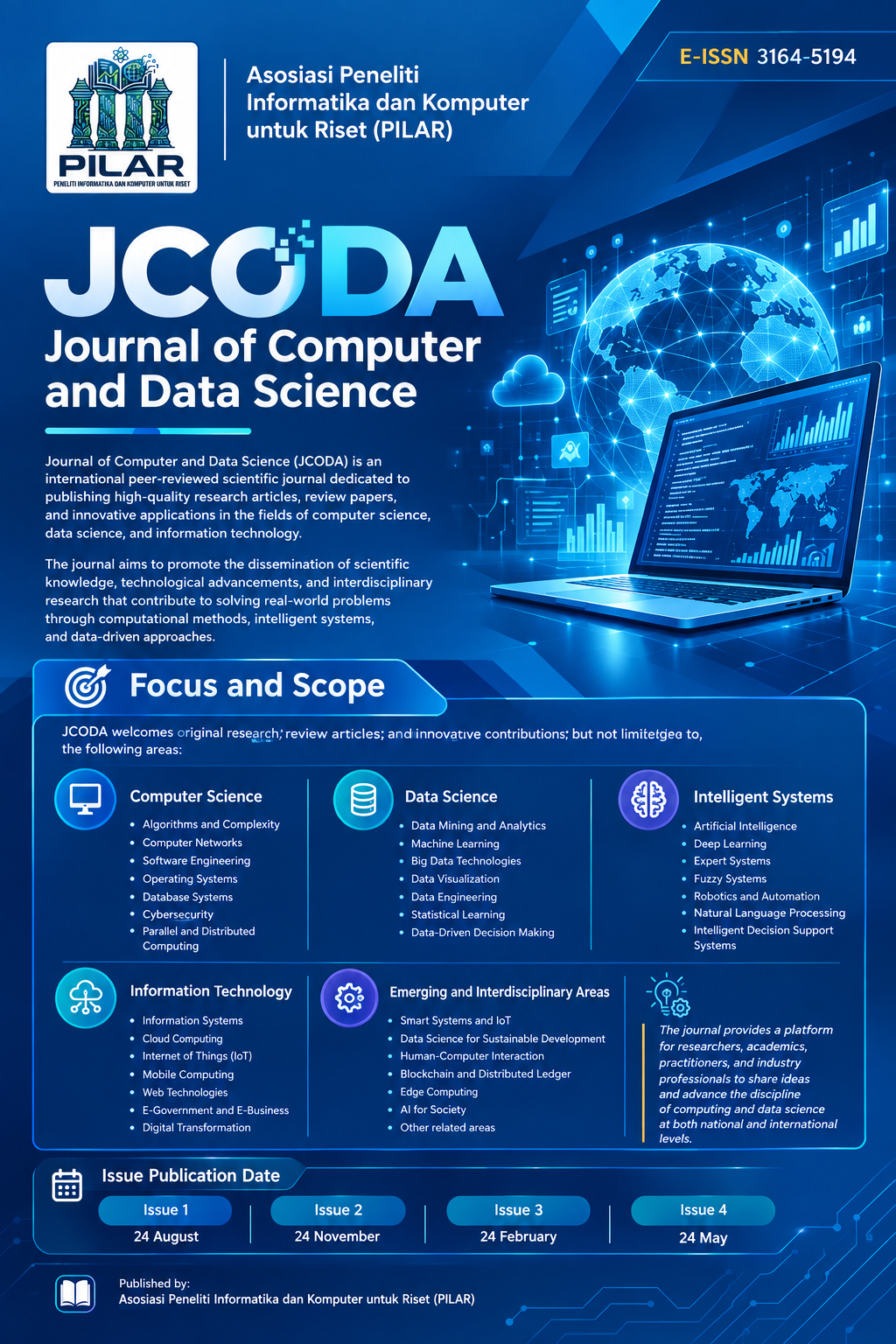
The Journal of Computer and Data Science (JCODA) welcomes the submission of original research articles, review papers, and technical studies in the fields of computer science, information technology, and data science. Authors are required to follow the guidelines below to ensure a smooth review and publication process.

1. Manuscript Preparation

Language

  • Manuscripts must be written in English.
  • Authors are encouraged to ensure grammatical accuracy and clarity before submission.

Originality

  • Submitted manuscripts must be original and must not have been published or be under consideration for publication elsewhere.
  • All submissions will be checked for plagiarism before entering the review process.

Article Length

  • Manuscripts must be at least 8 pages long, including figures, tables, and bibliography.

File Format

  • Manuscripts must be submitted in Microsoft Word (.doc or .docx) format.

2. Manuscript Structure

Authors should prepare manuscripts using the following structure:

  1. Title
  2. Author(s) Name and Affiliation
  3. Abstract (150–250 words)
  4. Keywords (3–5 keywords)
  5. Introduction
  6. Literature Review (Optional)
  7. Research Methodology
  8. Results and Discussion
  9. Conclusion
  10. CRediT Authorship Contribution Statement
  11. Declaration of Competing Interest
  12. Acknowledgments (Optional)
  13. Funding Statement
  14. Data Availability Statement
  15. Declaration of Generative AI and AI-Assisted Technologies in the Writing Process
  16. References

3. Title and Author Information

Title

  • Concise and informative.
  • Maximum 20 words.
  • Written in Title Case.

Author Information

Include:

  • Full name of each author.
  • Institutional affiliation.
  • Country.
  • Email address of the corresponding author.

4. Abstract and Keywords

Abstract

The abstract should:

  • Briefly describe the research background.
  • State the objective of the study.
  • Explain the methodology.
  • Present key findings.
  • Provide the main conclusion.

Keywords

  • Provide 3–5 keywords.
  • Separate keywords with semicolons (;).

5. Tables and Figures

Tables

  • Number tables consecutively.
  • Place table titles above the table.
  • Cite the source when applicable.

Figures

  • Number figures consecutively.
  • Place figure captions below the figure.
  • Ensure images are clear and of high quality.

6. Equations

  • Equations should be clearly written and numbered consecutively.
  • Variables and symbols must be defined when first introduced.

7. Additional Author Declarations

CRediT Authorship Contribution Statement

Authors are required to provide a CRediT (Contributor Roles Taxonomy) Authorship Contribution Statement describing the specific contributions of each author to the manuscript.

Example:

First A. Author: Writing – Review & Editing, Writing – Original Draft, Validation, Software, Methodology, Conceptualization.

Second B. Author: Writing – Original Draft, Formal Analysis, Data Curation, Conceptualization.

Third C. Author: Writing – Original Draft, Software, Investigation.

Authors should ensure that all listed contributors meet the criteria for authorship and that the contribution statement accurately reflects each author's involvement in the research and manuscript preparation.

Declaration of Competing Interest

Authors must disclose any financial, professional, or personal relationships that could influence the research results or interpretation.

If there are no conflicts of interest, authors should include the following statement:

Declaration of Competing Interest

The authors declare that they have no known competing financial interests or personal relationships that could have appeared to influence the work reported in this paper.

Funding Statement

Authors are required to disclose all sources of financial support for the research and preparation of the manuscript. The funding statement should identify the funding organization, grant number (if applicable), and the role of the funder in the research.

If the research received funding, authors should include the following statement:

Funding Statement

This research was supported by [Name of Funding Organization] under Grant Number [Grant Number].

If the research did not receive any specific funding, authors should include the following statement:

Funding Statement

This research received no specific grant from any funding agency in the public, commercial, or not-for-profit sectors.

Authors should ensure that all sources of financial support are accurately disclosed. If a funder had no role in the study design, data collection, analysis, interpretation, manuscript preparation, or decision to submit the article for publication, this should also be clearly stated.

Data Availability Statement

Authors are required to include a Data Availability Statement in their manuscript. Please select the statement that best applies to your study or provide a customized statement if necessary.

Examples include:

  • The data used to support the findings of this study are available from the corresponding author upon reasonable request.
  • All relevant data are included within the manuscript and its supporting information files.
  • The dataset supporting the conclusions of this article is openly available at: [provide repository link].
  • Data sharing is not applicable to this article as no datasets were generated or analyzed during the current study.
  • Data sharing is not applicable as the data are secondary data derived from previously published literature.
  • The datasets generated and/or analyzed during the current study are available from the corresponding author upon reasonable request.

Authors are encouraged to deposit datasets in recognized public repositories whenever possible to promote transparency and reproducibility.

Declaration of Generative AI and AI-Assisted Technologies in the Writing Process

To ensure transparency in scholarly publishing, authors must disclose the use of Generative Artificial Intelligence (AI) and AI-assisted technologies in the preparation of manuscripts.

If applicable, authors should include the following statement:

Declaration of Generative AI and AI-Assisted Technologies in the Writing Process

The authors used ChatGPT-[version] to improve the writing clarity of this paper. The authors reviewed and edited the AI-assisted content and take full responsibility for the content of the publication.

The use of AI tools is permitted only to improve language, readability, and presentation. Authors remain fully responsible for the accuracy, originality, integrity, and scientific validity of all submitted content. AI tools must not be listed as authors or co-authors.

8. Citation and References

JCODA uses the IEEE Referencing Style.

In-text Citation Examples

Single Source:

Recent studies have shown significant improvements in classification accuracy [1].

Multiple Sources:

Machine learning techniques have been widely adopted in various domains [2], [3].

Reference Examples

Journal Article

[1] J. Smith and A. Brown, "Machine Learning Approaches for Data Classification," IEEE Access, vol. 10, pp. 1234–1245, 2024.

Conference Paper

[2] R. Kumar and P. Singh, "Deep Learning for Image Recognition," in Proceedings of the International Conference on Artificial Intelligence, 2023, pp. 45–50.

Book

[3] I. Goodfellow, Y. Bengio, and A. Courville, Deep Learning. Cambridge, MA: MIT Press, 2016.

References Requirements

  • References should primarily consist of recent publications from the last 5–10 years.
  • At least 80% of references should come from scholarly journals, conference proceedings, or reputable scientific sources.
  • Authors are encouraged to use reference management software such as Mendeley, Zotero, or EndNote.

Manuscript Writing Guidelines

Instructions for preparing the main sections of the manuscript


Authors are required to prepare their manuscripts according to the following guidelines. Each section should be written clearly, systematically, and logically to ensure that the research can be properly understood and evaluated by reviewers and readers.

The manuscript should present a clear relationship between the research problem, methodology, results, discussion, and conclusions. Authors should ensure that each section contains sufficient information to explain the research process and support the validity of the findings.

Instructions
  • Follow the structure and order of the sections provided in the manuscript guidelines.
  • Explain the research problem and objectives clearly in the Introduction.
  • Describe the research procedures, data sources, methods, instruments, and analysis techniques in the Research Methodology.
  • Present the research findings systematically using appropriate text, tables, figures, and statistical results in the Results and Discussions.
  • Interpret the findings by relating them to the research objectives, previous studies, theories, and practical implications.
  • Summarize the most important findings and contributions of the study in the Conclusion.
  • Ensure that all statements, data, tables, figures, and references are accurate and properly cited.
  • Maintain consistency in terminology, formatting, numbering, citations, and references throughout the manuscript.
Introduction
Research Methodology
Results & Discussions
Conclusion
Important: Authors should ensure that the content of each section is directly related to the research objectives and that the manuscript provides a logical progression from the research problem to the methodology, findings, discussion, and final conclusions.

1. INTRODUCING

Establish the research context and explain why the study is important.


The Introduction should provide readers with sufficient background to understand the research problem, demonstrate the significance of the study, and clearly state the research objectives. It should gradually move from the general context toward the specific issue addressed by the manuscript.

What should be included?

  • Present the general background of the research area.
  • Explain the practical or theoretical problem being addressed.
  • Summarize relevant previous studies.
  • Identify research gaps or limitations in existing literature.
  • State the novelty and contribution of the study.
  • Clearly formulate the research objectives.
Recommended Structure
Background → Previous Studies → Research Gap → Novelty → Research Objectives.

2. RESEARCH METHODOLOGY

Describe how the research was conducted in a transparent and reproducible manner.


The Methodology section should explain every step of the research process clearly enough for other researchers to reproduce the study. The selected methods must be appropriate for achieving the stated objectives.

Essential Components

  • Research design and approach.
  • Data sources and collection procedures.
  • Population, sample, or experimental subjects.
  • Research instruments or tools.
  • Algorithms, models, or analytical techniques.
  • Data processing and validation procedures.
  • Software and computational environment.

For Computer Science Research

  • System architecture or workflow diagrams.
  • Algorithm descriptions or pseudocode.
  • Parameter settings.
  • Evaluation metrics.
  • Hardware and software specifications.
Recommended Flow
Research Design → Data Collection → Data Processing → Model Development → Evaluation → Validation.

3. RESULT AND DISCUSSIONS

Present findings objectively and interpret their scientific significance.


This section should present the research findings clearly and objectively before discussing their meaning. The discussion should explain why the results occurred, compare them with previous studies, and highlight their theoretical and practical implications.

Results

  • Present findings systematically.
  • Use tables and figures appropriately.
  • Report numerical values accurately.
  • Avoid repeating identical information in text and tables.

Discussion

  • Interpret the significance of findings.
  • Compare results with previous studies.
  • Explain similarities or differences.
  • Discuss limitations.
  • Highlight practical implications and future research opportunities.
Writing Tip
Every major result should be followed by an explanation, interpretation, and comparison with existing literature.

4. CONCLUSION

Summarize the main findings and emphasize the contribution of the research.


The Conclusion should directly answer the research objectives by summarizing the most important findings. It should emphasize the contribution of the study without merely repeating the Results section.

The Conclusion should:

  • Summarize the principal findings.
  • Answer the research objectives.
  • Highlight theoretical and practical contributions.
  • Acknowledge important limitations.
  • Suggest directions for future research.
Effective Conclusion Formula
Main Findings → Research Contribution → Practical Implications → Limitations → Future Work.